Native American history for elementary students examines how Indigenous peoples across North America created, maintained, and continue to preserve sophisticated systems of education, community life, and cultural knowledge spanning thousands of years before and after European contact. This educational approach focuses on centering Indigenous voices, correcting historical misrepresentations, and teaching young learners to understand Native American experiences through accurate, respectful narratives grounded in primary source media and community knowledge.
Understanding this history matters because elementary students form foundational beliefs about Indigenous peoples during these formative years. Too often, textbooks freeze Native Americans in the past or reduce hundreds of distinct nations to simplified stereotypes. The truth is more complex and inspiring: Indigenous communities developed rich educational traditions perfectly suited to their environments and values, teaching children through oral storytelling, hands-on practice, and intergenerational mentorship long before Western schooling arrived.
This article addresses how to teach Native American history authentically to young learners. We’ll explore how traditional Indigenous education systems functioned across different nations, what made these approaches effective for transmitting knowledge and cultural values, and how to present the difficult history of forced assimilation, including boarding schools, in age-appropriate ways. You’ll also discover how Native communities today are reclaiming and revitalizing Indigenous languages and teaching methods.
Educators and parents need resources that honor both historical truth and children’s developmental readiness. Teaching this history well means moving beyond craft projects and holiday lessons to help students recognize Native Americans as living peoples with continuous histories, diverse cultures, and ongoing contributions to our shared world. The approach outlined here respects Indigenous perspectives while making complex historical concepts accessible to elementary minds.
What Native American Education Meant Before European Contact
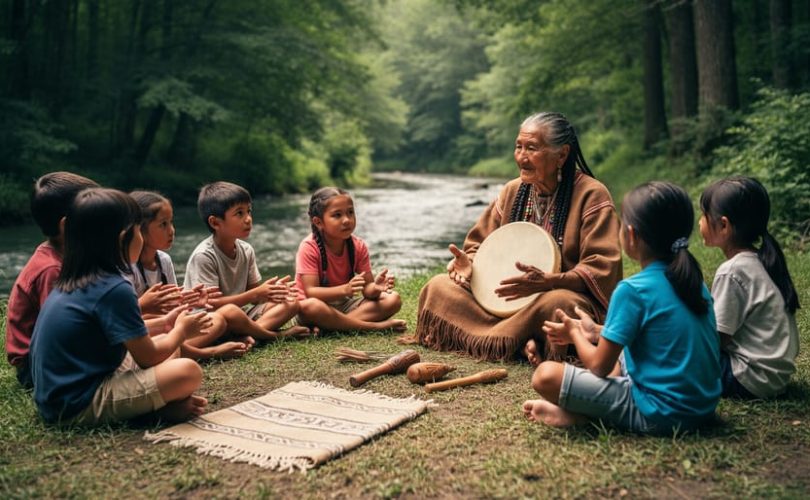
Before European ships arrived on North American shores, Native American children learned everything they needed to know without schools, textbooks, or chalkboards. Education happened everywhere, around the fire, in the fields, along riverbanks, and during ceremonies. A child learning to identify healing plants walked beside a grandmother through the forest. A young person mastering the art of basket weaving sat next to an aunt, watching fingers move through reeds until the pattern made sense. This was education: watching, doing, listening, and living the knowledge that kept communities strong.
Traditional Native American education centered on passing wisdom from one generation to the next through daily experience. Rather than separating children into age-based classrooms, communities understood that learning happened naturally when young people participated in real life. A five-year-old might learn songs while helping to prepare food. A ten-year-old could practice patience and observation during a fishing expedition. A teenager might join adults in decision-making councils, learning governance by listening to how elders worked through disagreements.
- Oral Tradition
- The practice of sharing knowledge, history, and cultural values through spoken stories, songs, and teachings rather than written texts. These carefully memorized narratives preserved thousands of years of accumulated wisdom.
- Experiential Learning
- Education that happens through direct participation and hands-on practice in real situations rather than abstract lessons. Children learned by doing actual tasks alongside skilled community members.
- Cultural Transmission
- The process of passing language, customs, values, and identity from elders to younger generations. This ensured that tribal knowledge and ways of life continued across centuries.
- Ceremony-Based Education
- Learning that took place during spiritual practices, seasonal celebrations, and rituals. Ceremonies taught not just religious beliefs but also history, social roles, and ecological knowledge.
- Intergenerational Teaching
- A system where people of all ages learned from each other, with elders, parents, aunts, uncles, and older siblings all serving as teachers. Knowledge flowed in multiple directions across age groups.
Every adult in the community had something valuable to teach. The best hunter shared tracking skills. The most skilled potter demonstrated clay preparation. The eldest storyteller held the history of the people. The medicine person understood which plants healed specific ailments. When someone needed to learn something, they found the person who knew it best and spent time with them, absorbing knowledge through observation and guided practice.
This educational approach meant children grew up understanding their place within a web of relationships, to their families, their nation, the natural world, and the spiritual realm. Learning wasn’t separate from living. It was woven into every sunrise, every harvest, every gathering, and every season’s change. The goal wasn’t to fill a child’s head with facts to recite but to help them become a capable, responsible member of the community who could contribute to collective survival and cultural continuity.
How Traditional Indigenous Learning Worked
Learning Through Stories and Oral Tradition
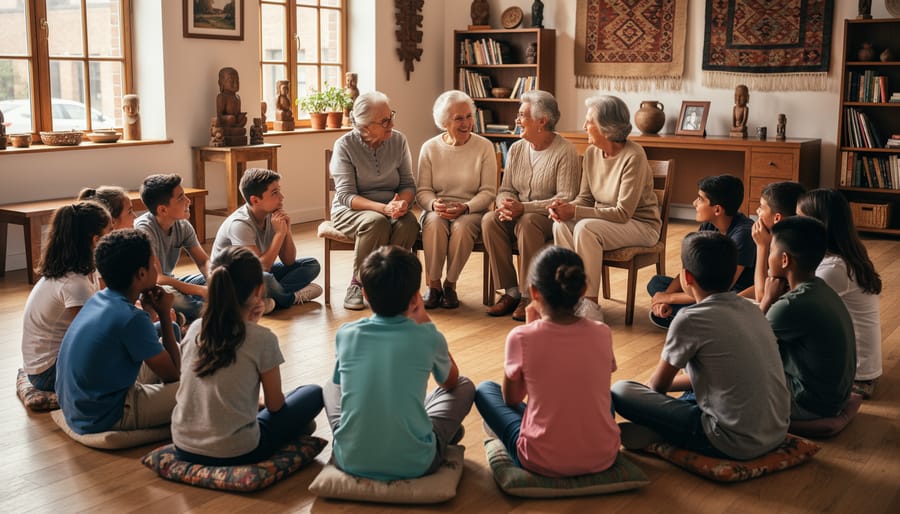
Before European contact, Native American communities used stories, songs, and oral histories as their primary teaching tools. These weren’t just entertainment, they were carefully crafted lessons passed down through generations, serving the same purpose as textbooks do today.
Stories taught children how to survive in their environment. A tale about how Coyote learned to find water during drought contained real information about which plants indicate underground springs. Legends about the stars helped young people navigate at night and understand seasonal changes for planting crops.
Oral traditions preserved scientific knowledge too. The Ojibwe people’s stories about the “seven prophets” encoded hundreds of years of migration history and environmental observation. Cherokee narratives about plants included detailed information about which ones healed illnesses and when to harvest them.
Songs reinforced these lessons through rhythm and repetition, making complex information easier to remember. Because nothing was written down, every word mattered. Elders memorized thousands of stories with exact precision, and children learned to listen carefully and remember accurately, skills essential for preserving their nation’s knowledge.
This oral teaching system worked for thousands of years, allowing each generation to build upon the wisdom of those who came before.
Hands-On Learning and Community Participation
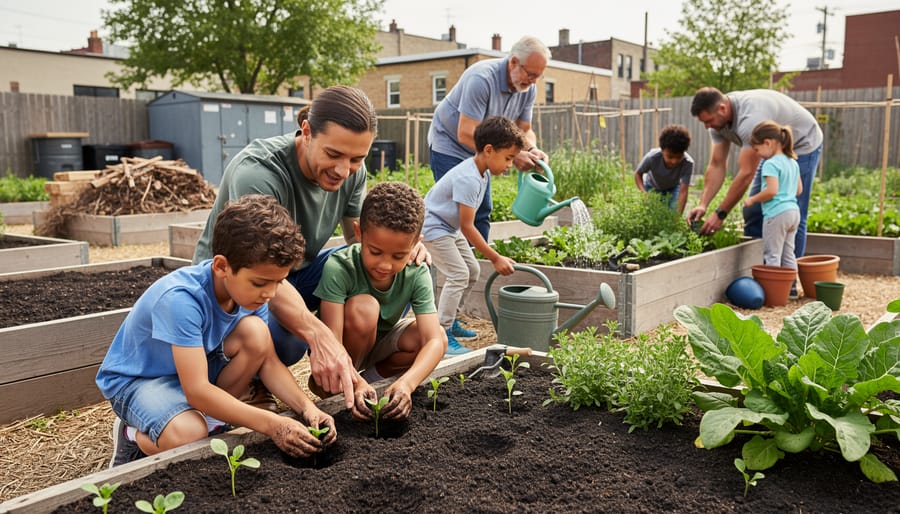
In traditional Native American communities, children learned by doing, not by sitting in classrooms. From a young age, they joined adults in daily activities, gathering plants, preparing food, making tools, and tending crops. A Hopi child might help plant corn while learning which seeds grew best in sandy soil and when the rainy season would arrive. A Lakota child could practice setting snares for small animals before joining larger hunting parties.
This wasn’t practice for someday. It was real work that fed families and strengthened communities. Boys and girls watched their parents and relatives closely, then tried the skills themselves. Mistakes became lessons. A basket woven too loosely taught how to tighten the weave. A fish that got away showed how to read water currents better.
Ceremonies and seasonal gatherings offered more learning opportunities. Children helped prepare for powwows, learned songs during harvest celebrations, and discovered medicinal plants during communal gathering trips. Everyone contributed according to their ability, and every task carried knowledge forward. This community-wide teaching meant children understood how their individual skills fit into their nation’s survival and culture.
The Role of Elders and Knowledge Keepers
In Native American communities, elders weren’t just old people, they were living libraries. They held stories, songs, and knowledge that went back hundreds of years, passed down through their own teachers and experiences.
Each elder or knowledge keeper often specialized in specific areas. Some taught medicinal plants and healing practices. Others knew the patterns of stars for navigation and planting. Spiritual leaders guided ceremonies and explained the relationships between people, animals, and the land. Craft masters shared techniques for weaving, pottery, or tool-making that had been perfected over generations.
Children learned different things from different teachers based on what they needed to know and what they showed interest in. A child curious about plants might spend time with the medicine keeper. Someone drawn to stories would sit with the historian who remembered tribal events and family connections.
This system worked because knowledge lived in people, not books. If an elder didn’t pass along what they knew, it could disappear forever. That’s why listening and respecting elders remained central to Native education, they carried irreplaceable wisdom that connected past generations to future ones.
Different Forms of Native American Education Across Nations
Just as no single language united all Native American peoples, no single education system existed across the hundreds of distinct tribal nations. Each community developed unique teaching methods shaped by their environment, ways of life, and cultural values. A child growing up in the woodlands of the Northeast learned different skills and knowledge than one raised on the Great Plains or along the Pacific coast.
The Haudenosaunee (Iroquois) Confederacy of the Northeast developed sophisticated systems for teaching governance and diplomacy alongside practical skills. Children learned the Great Law of Peace, which outlined democratic principles and conflict resolution centuries before European arrival. Young people observed council meetings where decisions required consensus, absorbing lessons about cooperation, listening, and speaking with purpose. They also learned seasonal agriculture, particularly the cultivation of corn, beans, and squash, the Three Sisters, which required understanding companion planting and soil care. These nations lived in permanent longhouse villages, allowing for structured apprenticeships where children could study with specialized craftspeople and leaders over many years.
Plains nations like the Lakota and Cheyenne, who followed buffalo herds across vast grasslands, created mobile education systems suited to constant movement. Children learned to read animal tracks, predict weather from clouds and wind, and identify edible plants across changing landscapes. Young boys practiced with smaller bows before joining hunts, while girls learned to process hides and preserve meat, skills that required precise timing and knowledge passed through demonstration. Indigenous games like the hoop-and-pole game taught hand-eye coordination needed for hunting. These communities valued adaptability and observation because survival depended on responding to seasonal migrations and environmental changes.
In the Southwest, Pueblo peoples built permanent adobe villages in the desert and developed education centered on water conservation, astronomy, and ceremonial cycles. Hopi and Zuni children learned complex irrigation techniques and the agricultural calendar that determined planting and harvesting times. They studied the movements of stars and planets, which guided both farming and ceremonies. Knowledge about maintaining kivas (ceremonial chambers) and performing seasonal dances passed to specific individuals chosen for these responsibilities, creating specialized educational paths within the community.
Northwest Coast nations like the Tlingit, Haida, and Kwakwaka’wakw developed education systems tied to ocean resources and complex social structures. Children learned to identify fishing grounds, understand tidal patterns, and respect salmon cycles that sustained their communities. The potlatch tradition served as a powerful teaching tool, where families demonstrated wealth through elaborate gift-giving ceremonies that reinforced social obligations, oral histories, and clan relationships. Young people learned their family’s crest stories and the responsibilities that came with their social position. Apprentice carvers studied for years to master the creation of totem poles and masks, with knowledge about design, wood selection, and symbolic meaning transmitted through careful mentorship. These communities also preserved knowledge through media collections of woven blankets and carved objects that recorded histories and teachings in visual form.
Each system reflected what children needed to thrive in their specific homeland and culture, proving that effective education takes many forms.
The Disruption: Boarding Schools and Forced Assimilation
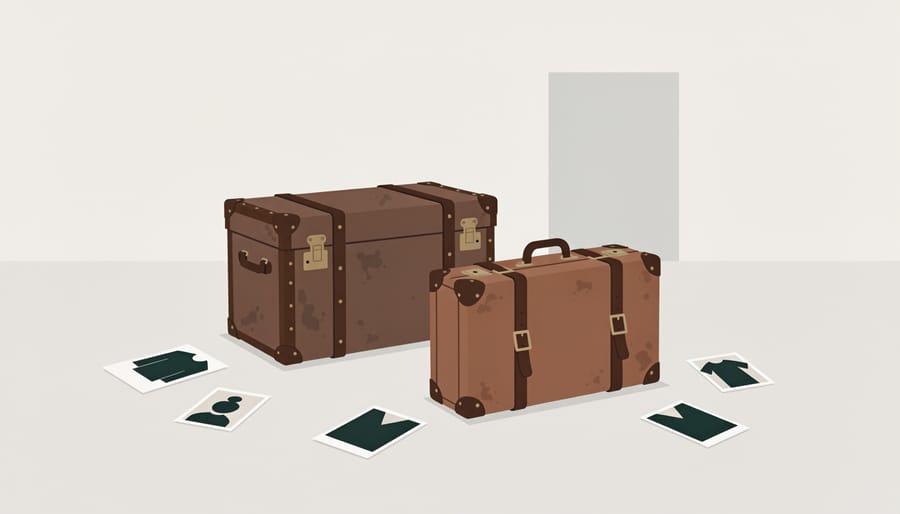
Starting in the 1870s, the United States government made a devastating decision that would change Native American communities forever. Officials believed that forcing indigenous children to abandon their cultures would solve what they called the “Indian problem.” Working with Christian churches, the government opened special schools designed to erase Native identities and replace them with European American ways of life.
These institutions, known for their focus on boarding schools and assimilation operated under a cruel motto coined by Captain Richard Henry Pratt: “Kill the Indian, save the man.” This “Kill the Indian” policy meant destroying everything that made Native children who they were, their languages, their spiritual practices, their connections to family and land, while claiming to “help” them by teaching them to be like white Americans.
Government agents and law enforcement officers arrived at reservations and took children from their families, sometimes by force. Parents who tried to hide their children or resist faced jail time or loss of food rations. Thousands of children, some as young as five years old, traveled hundreds of miles away from home to these schools. Many would not see their families for years.
Once there, children faced strict rules intended to strip away their Native identities. Teachers cut their long hair, a deeply spiritual practice in many tribes. Staff forced them to wear uniforms and forbade them from speaking their own languages, even to siblings. Children caught using their Native tongue faced punishment, beatings, mouth-washing with soap, or isolation. They learned English, vocational skills like farming or sewing, and Christian prayers, but not the knowledge their elders had been ready to share.
The conditions at many boarding schools were harsh and sometimes dangerous. Children lived in overcrowded dormitories, ate poor-quality food, and received inadequate medical care. Diseases like tuberculosis and influenza spread quickly. Thousands of children died far from home, buried in unmarked graves that families would not discover until decades later.
This system continued into the 1970s, affecting multiple generations. The last government-run boarding school did not close until 1973, though some church-run schools operated even longer. The trauma did not end when the schools closed. Survivors returned home unable to speak their own languages or practice their traditions. Many struggled with the pain of what they had experienced, and that hurt passed down through families. Understanding this painful chapter helps us recognize why language revitalization and cultural healing remain so important in Native communities today.
How Native American Education Is Used Today
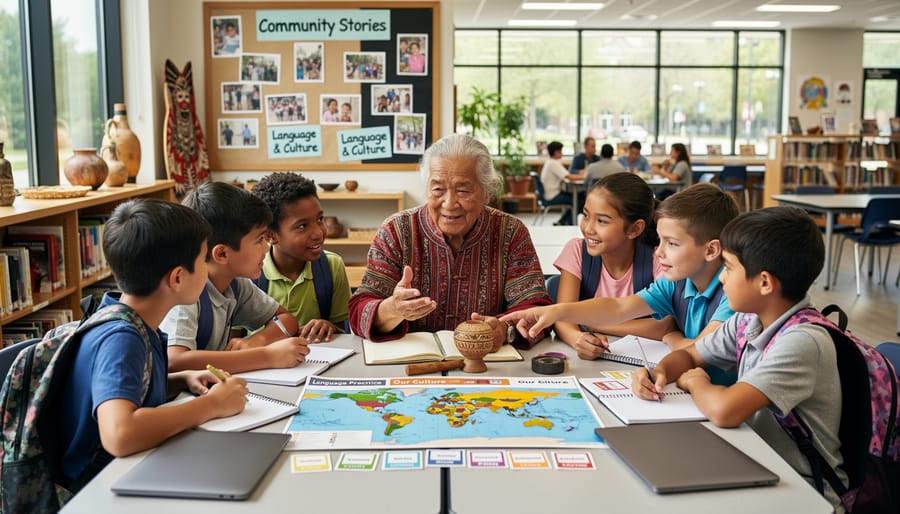
Today, Native American communities are rebuilding their education systems on their own terms, combining the wisdom of traditional teaching with academic skills students need in 2026. Tribal schools across the country now teach subjects like math and science alongside language classes, storytelling sessions, and land-based learning that connects students to their ancestors’ knowledge. The Navajo Nation, for example, operates more than 60 schools where children learn both English and Diné Bizaad, while studying their people’s history from indigenous perspectives rather than solely from textbooks written by outsiders.
Language revitalization programs have become central to educational sovereignty. Many tribes lost their languages during the boarding school era, but communities are bringing them back through immersion schools where young children spend their entire school day speaking, singing, and learning in their ancestral tongue. The Māori model from New Zealand has inspired similar programs among tribes like the Blackfeet and Cherokee, proving that languages once thought nearly extinct can thrive again when communities commit to reclaiming through stories and daily practice.
Current indigenous education takes many forms:
- Tribal colleges and universities offering degrees rooted in indigenous knowledge systems
- Language immersion schools where instruction happens entirely in Native languages
- Culture-based curricula that teach academic concepts through traditional practices
- Elder-in-residence programs connecting students directly with knowledge keepers
- Land-based education initiatives using the environment as classroom
- Digital preservation projects recording teachings for future generations
These programs demonstrate that traditional teaching methods work just as well in modern settings. Students learn geometry through beadwork patterns, understand ecology through traditional hunting and gathering knowledge, and study governance by examining their nations’ decision-making systems. The principles of Indigenous data sovereignty ensure communities control how their knowledge is shared and preserved.
Perhaps most importantly, tribal nations are reclaiming control over what their children learn and how they learn it. Instead of federal or state governments deciding curriculum, tribes are designing education that prepares students to succeed in both indigenous communities and the wider world, honoring the past while building the future.
Lessons for All Students
Understanding the history of Native American education offers valuable lessons that can improve how all students learn today. One of the most important insights is that knowledge comes in many forms. Indigenous education systems remind us that learning happens not just from textbooks, but through stories, hands-on experience, and observation of the natural world.
Community-based learning stands as another powerful lesson. Traditional Native American education involved entire communities working together to teach children. Grandparents, parents, aunts, uncles, and neighbors all shared their expertise. This model challenges the idea that learning only happens with one teacher in one classroom. When students learn from multiple people with different skills and perspectives, they gain a richer, more complete education.
Environmental stewardship represents a core element of indigenous education that has become increasingly relevant. Native American communities taught children to observe nature closely, understand seasonal cycles, and respect the interconnection of all living things. These lessons about sustainable living and environmental responsibility are now recognized as essential for all students in 2026, as communities worldwide work to protect natural resources.
Intergenerational knowledge sharing demonstrates another approach worth adopting. While modern schools typically group students by age, indigenous education paired younger learners with elders who held specialized knowledge. This created meaningful connections across generations and ensured important cultural information was not lost. Many schools today are rediscovering the benefits of mentorship programs that bring different age groups together.
Cultural preservation matters to every community. Just as Native American nations work to maintain their languages, traditions, and histories, all students can learn the importance of knowing where they come from and protecting what makes their own communities unique.
How The History of Native American Education Systems Works
Understanding how Native American education systems worked means seeing education as a living cycle rather than a set of lessons. Knowledge flowed from the oldest community members to the youngest through daily interaction. A child learning to fish didn’t just memorize techniques, they watched an elder read the water, felt the rhythm of casting, and understood why certain spots yielded more fish during specific moon phases.
This process repeated across every skill and piece of cultural knowledge. Seasonal changes triggered different learning opportunities. Spring brought lessons about planting or following game migrations. Winter gatherings focused on storytelling and crafts. Each community member contributed their expertise when the moment called for it.
The system worked because it connected learning directly to survival, identity, and community wellbeing. Children absorbed language, values, and practical skills simultaneously. A girl learning beadwork wasn’t just practicing a craft, she was engaging with geometric concepts, cultural symbols, and family history all at once.
This interconnected approach meant education happened constantly, not in isolated chunks. Every activity carried multiple layers of meaning, and learning continued throughout a person’s entire life as they gained new responsibilities and deeper understanding.
Native American education has traveled a long path. For thousands of years before Europeans arrived, indigenous children learned through stories, hands-on practice, and guidance from elders. They mastered survival skills, understood their environment deeply, and carried forward the traditions of their nations. Education happened everywhere: in homes, during hunts, around fires, and through ceremonies. Every adult was a potential teacher, and learning never stopped.
Then came forced change. Beginning in the 1870s, boarding schools tried to erase indigenous languages and cultures, causing deep harm that affected generations. Children were taken from their families and punished for being themselves. Yet Native communities never gave up. They protected their knowledge, kept their languages alive in secret, and fought to reclaim their right to educate their own children.
How did Native American children learn to read before Europeans came?
Most Native nations used oral traditions rather than alphabets, but they had sophisticated systems for recording information through wampum belts, pictographs, and other methods. Reading meant interpreting these symbols and understanding the stories they represented.
Did Native Americans have schools?
They had education systems but not buildings called schools. Learning happened through daily life, with elders teaching children skills, stories, and cultural knowledge in natural settings and community gatherings.
Why were boarding schools harmful?
Boarding schools forcibly separated children from their families, banned their languages and traditions, and tried to destroy their cultural identities. This caused trauma that affected entire communities for generations.
How can I learn more about local Native history?
Visit tribal museums and cultural centers, attend public events hosted by local nations, and read books written by indigenous authors. Always approach with respect and a willingness to listen.
Today, indigenous communities are revitalizing traditional teaching methods while running their own schools and programs. They combine ancestral wisdom with modern academics, proving that there are many valid ways to learn. Understanding this history shows us that education is bigger than classrooms and textbooks. It reminds us to respect different knowledge systems and to learn from the land, our communities, and each other throughout our lives.